
For Newly Engaged Couples Who Aren't Sure What They're Supposed To Figure Out First
Lock Your Budget and Guest Count in One Evening, and Know Exactly Which Venues to Look At...
Without Six Months of Research or a Wedding Planner's Fee.
Even if right now you have no idea what a wedding should cost, how many people you'll invite, or where you'll have it.
A guided web app, plus companion PDF GUIDE, that walks you and your partner through the three foundational wedding decisions, in the right order, STARTING TONIGHT.
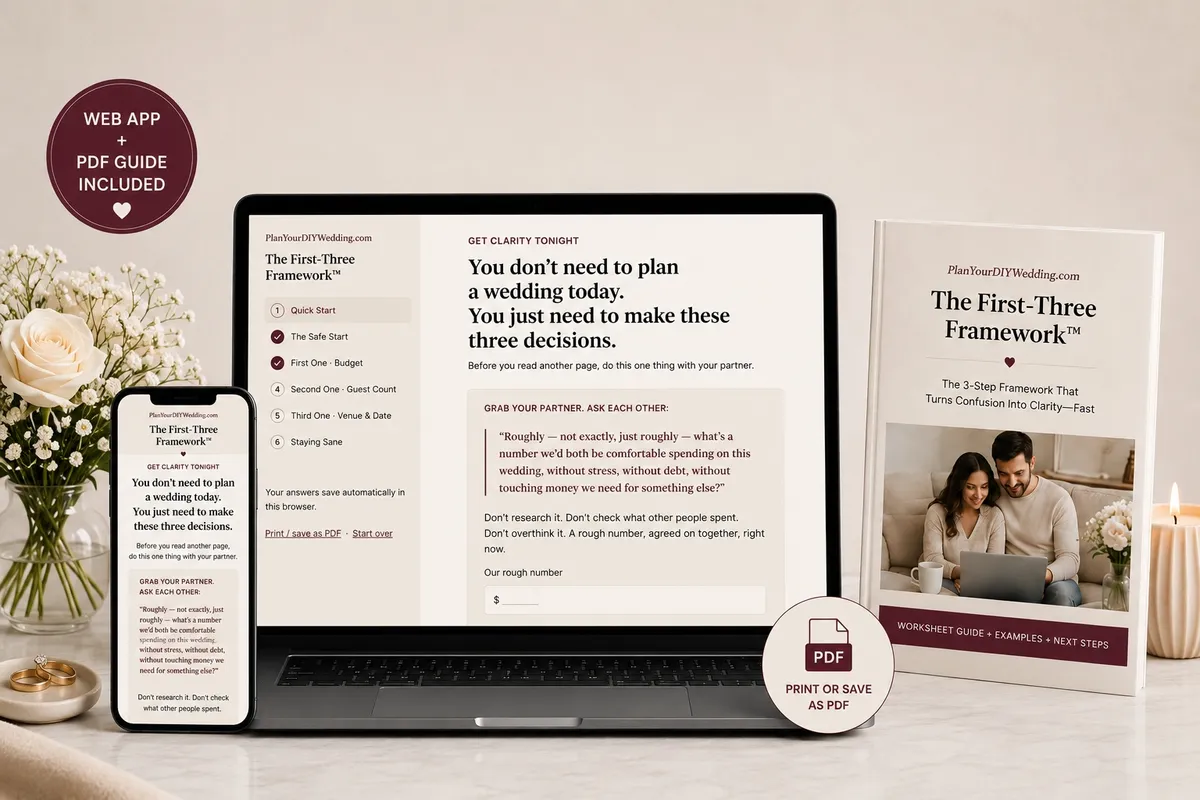
No subscription. Works on your phone or laptop.
You're engaged!
You're supposed to be excited. And you are.
But almost immediately, something strange happens. The questions start.
“When's the wedding?”
“Where are you having it?”
“How many people are you inviting?”
“Have you looked at venues?”
“What's your budget?”
Suddenly you're supposed to have an entire plan for a wedding you only just started thinking about.
So you do the sensible thing.
You start looking for answers.
You open a wedding checklist. You browse venues. You lose an evening to Pinterest.
Maybe you start a spreadsheet. Maybe you ask married friends. Maybe you start googling what a wedding actually costs.
And then you hit the wall.
Every Answer Requires Another Answer First.
How do you choose a venue without knowing how many people it holds?
How do you set a guest count without knowing what you're prepared to spend?
Do you lock a date before you know whether the venues that fit are even available?
Round and round you go.
Budget. Guest count. Venue. Date. It looks like four separate tasks.
They're not. They're connected.
Each one changes what the others can be. So solving them all at once doesn't create clarity, it creates a loop.
More tabs. More options. More opinions. Still no decision you feel ready to make.
And the loop has a cost.
Popular venues book 12 to 18 months out.
Every week you're stuck on “what do we decide first” is a week you can't book anything, and the dates and venues you'd actually want go to the couples who decided first.
There are two kinds of engaged couples
The ones who circle the same four questions for another month.
And the ones who lock their budget and guest count tonight, and move on.
Another Checklist Won't Fix the Beginning...
Nothing wrong with a checklist. You'll need one eventually ...photographer, flowers, catering, music, and a hundred things after that.
But a checklist answers one question: what needs to get done?
That's not the question you're stuck on. Right now the question is what do we decide first?
Different problem. And more organizing won't solve it, neither will another opinion, another Pinterest board, or another hour comparing venues.
The beginning of wedding planning doesn't need more tasks.
It Needs an Order.
30-day money-back guarantee
Here's the Shift
Make the decisions that create clarity before the decisions that reduce flexibility.
Every major wedding commitment locks something in. Once you commit the money, your flexibility drops. Once you book the venue, everything else has to fit around it. Once you fix an exact date, your venue options shrink.
So the question isn't “what should we work on today?” It's: which decision gives us the information we need to make the next one?
That's what the First-Three Framework is built on.
The First-Three Framework™
It takes the four biggest questions...budget, guest count, venue, date...and turns them into three connected decisions you make in order.
Not perfectly. Not recklessly.
You work each one until it's decision-ready, lock it, and move on.
Each locked decision hands the next one the information it needs...which is why you can lock the first two tonight, and know exactly how to filter through venues, instead of waiting weeks on answers that were never coming.
The Three Decisions
First One: Your Money. What you're planning around, and the ceiling you won't cross.
Second One: Your Count. The guest number that has to fit inside your First One.
Third One: Your Place & Date. Your First One and Second One become filters. You shortlist only the venues that clear both, then confirm a date that's actually open.
By the end you know how much you're working with, what fits inside that number, and exactly which venues are worth pursuing.
Knowing Budget Comes First Isn't The Hard Part
Half the internet will tell you to start with the budget. The trouble starts after that.
How do you know you've thought about the budget enough?...Enough to stop researching, commit, and build the next decision on top of it?
Most couples never feel that certainty, so the question stays open for weeks.
And when you're deep in venue tours and realize the budget needs to shift how do you move it without every decision downstream coming apart?
The framework answers both:
The Ready-to-Lock Check™ - The test each decision passes before you move on. Not “do you know everything”... you never will ...but “is this solid enough to build on.” It's what turns deciding into decided.
The Reopen Rule - How to change an earlier decision on purpose, when something genuinely warrants it, without the rest of the plan unravelling.
That's the part you'd otherwise spend the next month working out by trial and error.
30-day money-back guarantee
Why This Is a Sequence, Not an Opinion
Most wedding advice is someone's preference dressed up as a rule. This isn't.
The First-Three Framework was built from hundreds of wedding forum posts and Reddit threads...specifically, every “I just got engaged, where do I even start?” thread or post we could find. 318 of them, going back to 2009. The same question, asked the same way, year after year.
The replies were always a version of the same checklist. But a checklist answers what needs doing, not what to decide first. The real question went unanswered for over 15 years.
So the four decisions were mapped against each other:
A realistic guest count depends on the budget.
A venue shortlist depends on the guest count.
A date depends on which venues actually fit.
Each decision only works once the one before it exists. That's not a planning problem...it's a sequencing problem, and sequencing has a right answer.
The contradictions are easy to check yourself. Search “what to plan first for a wedding” and the top results disagree outright...venue first; no, budget first; no, date first. They can't all be right. The problem was never a lack of information. It's that the information contradicts itself.
The same pattern held across the threads. One post put it plainly: a couple delayed planning a few months, then found the venues in their area booked more than a year out for the dates they wanted. Their takeaway for everyone after them...set the budget first, use it to build the guest list, let the guest list decide the venue size.
That's the order this framework runs. It wasn't invented. It was pulled from over 15 years of couples learning it the hard way.
30-day money-back guarantee
What Each Decision Gives You
Three decisions. Each ends with something concrete written down, and something you probably didn't know to look for.
SAFE START
Quickly Agree On What Matters
It all starts with a 15-minute Safe Start: you and your partner agree on your non-negotiables and who gets a say, before any number gets locked.
FIRST ONE: YOUR MONEY
Know What You're Working With.
You end with two numbers, not one: the number you plan against, and the hard limit you won't cross. Most couples never separate those, which is exactly how budgets creep.
You'll also know how to handle money offered by family before it quietly turns into a say in your decisions.
SECOND ONE: YOUR COUNT
Know What Needs To Fit.
You end with your real invite number, and a separate, larger number you shop venues against. They're not the same, and using the wrong one is how couples fall for a space they can't fill, or can't afford.
This is where you find out fast whether the wedding you're picturing fits the numbers from your First One, before you tour a single venue.
THIRD ONE: YOUR PLACE & DATE
Know Where It Works - Then When.
Your First One and Second One become a filter.
You end with a short, real list: the three or four venues that actually clear your budget, your size, and your timing, instead of ninety options and no way to choose. Confirming availability is the next step, not tonight's.
Skip the filter and you fall for a place before you know it fits, then every other decision bends around a room.
30-day money-back guarantee
How You'll Use It
The whole framework runs inside a guided web app. You and your partner sit down together and it walks you through one decision at a time:
Answer the questions for that decision → run the Ready-to-Lock Check → lock it → move to the next.
No spreadsheet to build. No checklist to manage. It holds the structure so you can just make the calls.
By The End Of The Night
You'll know how much you're working with, what fits inside it, and what a venue has to clear before it's worth calling.
And the next morning:
When someone asks “so what's the budget?” - you have a number, and you say it without the knot in your stomach.
You and your partner stop having the same circular money conversation every evening.
You'll know exactly what to filter venues by, so you're not scrolling through ninety that don't fit.
You've got your evenings back.
Before you lock anything, each step surfaces both partners' non-negotiables. And if something genuinely can't move, like a date that's truly fixed or a hard spending limit that can't stretch, the framework builds around it instead of pretending every couple is the same.
Working through these three yourself, in the wrong order, is how couples can lose a $500 deposit on a venue that turns out too small, or pay a planner often $200–$300 just to be told where to start. This is $17, and it's the start.
30-day money-back guarantee
Plus These FREE Bonuses
Bonus #1:
The “Family & Friends” Deflection Scripts
What to say when everyone wants an answer before you're ready to give one.
Word-for-word replies to the questions that start within minutes of the ring: “When's the wedding?” “What's the budget?” “You have to invite them.” Plus how to hold a decision you've already locked, and how to find out whether family money has strings before you count it.
Value: $27
Bonus #2:
The “Decision Rescue” Guide
Already planning out of order? Get back on track without starting over.
If you've already picked a date, started a guest list, taken family money, or booked something, this walks you back to the right sequence from wherever you are now.
Value: $27
Everything You Get Today For $17
The First-Three Framework™
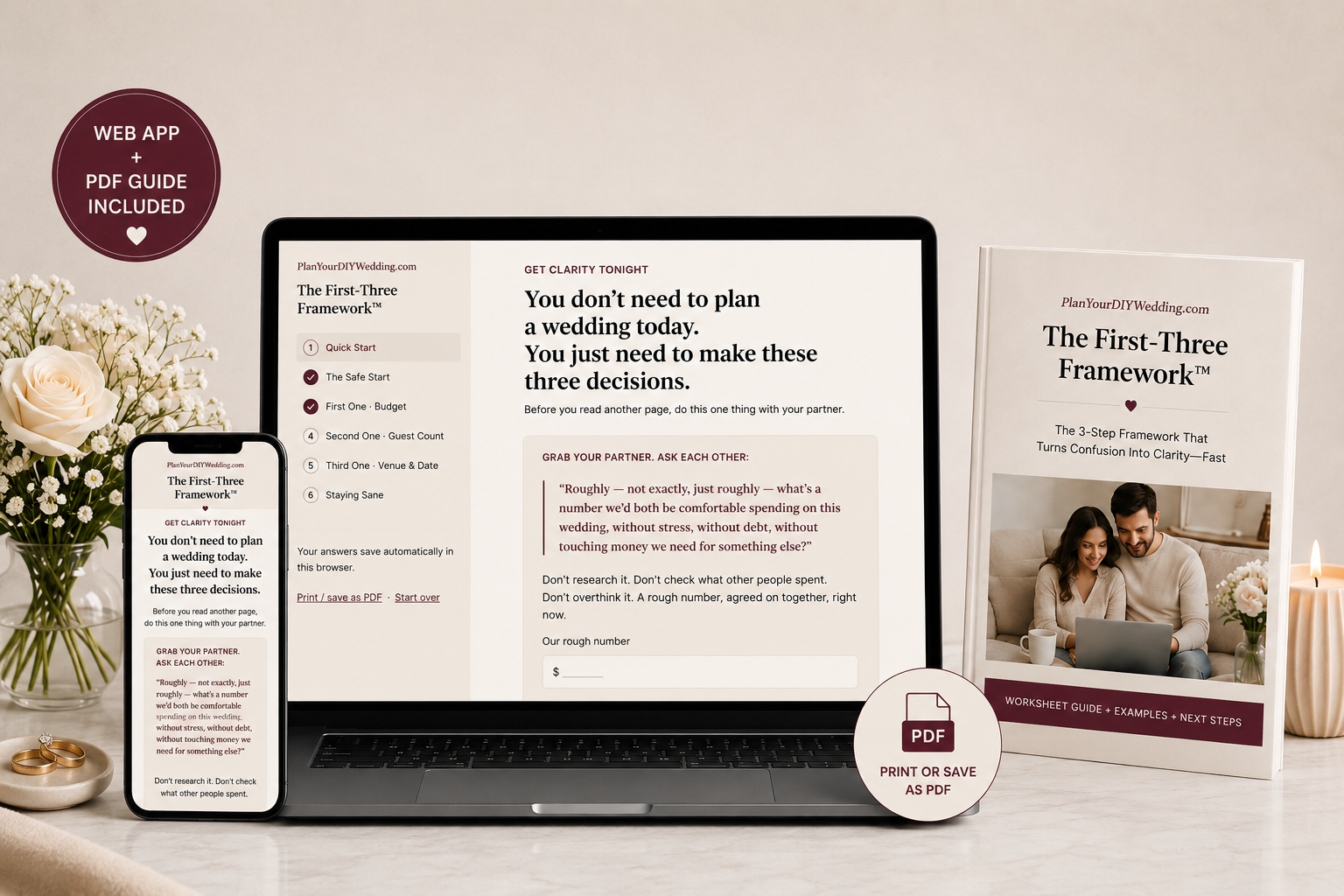
The Guided App. All Three Decisions
You don't need the whole wedding planned tonight.
Just the decision in front of you.

Here's what you get:
The First-Three Framework: The guided app & companion PDF guide ($47 value)
Bonus: “Family & Friends” Deflection Scripts ($27 value)
Bonus: “Decision Rescue” Guide ($27 value)
Total value: $101
Today Just $17
One payment. No subscription. Instant access.
The First-Three Framework™
The Guided App. All Three Decisions
You don't need the whole wedding planned tonight.
Just the decision in front of you.
Here's what you get:
The First-Three Framework: The guided app & companion PDF guide ($47 value)
Bonus: “Family & Friends” Deflection Scripts ($27 value)
Bonus: “Decision Rescue” Guide ($27 value)
Total value: $101
Today Just $17
One payment. No subscription. Instant access.
The 30-Day “Lock Your First Three” Guarantee
Sit down with your partner and work through your First One. If you don't walk away with a budget number you both agree on and a clear next step, send an email to [email protected] within 30 days and we'll refund every cent.
Keep both bonus guides either way.
30-day money-back guarantee
Frequently Asked Questions
What do I actually get, and how?
Instant access to the First-Three Framework — a guided web app you open in your browser, phone or laptop, plus a companion PDF guide you can print or work through offline. The moment you pay, you get access and can start. The two bonus guides download from the same confirmation email. Nothing to install, no subscription, yours for good.
How is this different from the free checklists I've already tried?
A checklist tells you what needs doing — photographer, flowers, catering. It doesn't tell you what to decide first. This is built entirely around the order your four biggest decisions have to happen in, so they stop blocking each other.
How long does it take?
Plan on one evening for budget and guest count: about 15 minutes to get oriented, then you and your partner can lock both together. Venue and date take a bit longer, since you're contacting real venues and waiting on real availability, but you'll know exactly which ones to call, instead of scrolling for another month first.
Is it complicated or technical?
No. The app asks one question at a time, won't let you lock a decision until every box in its Ready-to-Lock Check is ticked, and saves each answer in your browser so you're not tracking anything on paper. You can download a backup file any time. If you can fill in an online form, you can do this.
Do we both have to be there?
It works best with both of you — several steps surface each partner's non-negotiables before anything gets locked. You can start solo, but you'll want your partner for the actual decisions.
We've already started looking at venues. Too late?
No. You bring the budget and guest-count filters into the venues you're already considering — the question just becomes whether they actually fit. The Decision Rescue guide covers exactly this.
What if our date genuinely can't change?
Then it's a fixed constraint, and the framework builds around it. A locked date just changes which venues you're filtering for.
What if we change our minds after locking a decision?
That's what the Reopen Rule is for. “Locked” doesn't mean permanent, it means you don't quietly rewrite an earlier decision because a later option looked shiny. If something real changes, you name what changed, decide together, and re-lock on purpose.
What if it doesn't work for us?
Work through your First One. If you don't land on a budget number you both agree on, send an email to [email protected] within 30 days for a full refund, and keep both bonus guides.
Is $17 really worth it?
One deposit on a wrong-sized venue is a few hundred dollars you don't get back. A planner's first session is $200–$300. The framework and both bonus guides sell separately for $101. You get all of it for $17.
You Don't Need 100 Wedding Answers Today
You need somewhere solid to start. One decision. Then the next. Then the third one, which the first two make simple.
You're not behind. You're a few weeks in. The only thing you need right now is the next move, not the whole plan.
First One
Know what you're working with.
↓
Second One
Know what needs to fit.
↓
Third One
Know which venues are worth pursuing.
“Make the decisions that create clarity before the decisions that reduce flexibility.”
Instant access • One-time $17 • No subscription
30-day money-back guarantee
P.S. Every major wedding commitment costs you a little flexibility. The venue narrows your dates. The date narrows your venues. The deposit narrows everything. Lock your first three now, while you still have the most room to move.
Not affiliated with or endorsed by The Knot, Zola, or any wedding planning platform. Results depend on following the framework.
© 2026 PlanYourDIYWedding.com. All Rights Reserved.
Get Started | Privacy Policy | Terms | Login
© 2026 PlanYourDIYWedding.com. All Rights Reserved.
Privacy — Terms — Login